During this time of the holiday season, some of us begin to begin again thinking about our New Year’s resolution on a quest for self-improvement. What will the focus be this year? Weight regulation? Stress reduction? Improvement of mood? Bringing more optimism into your life?
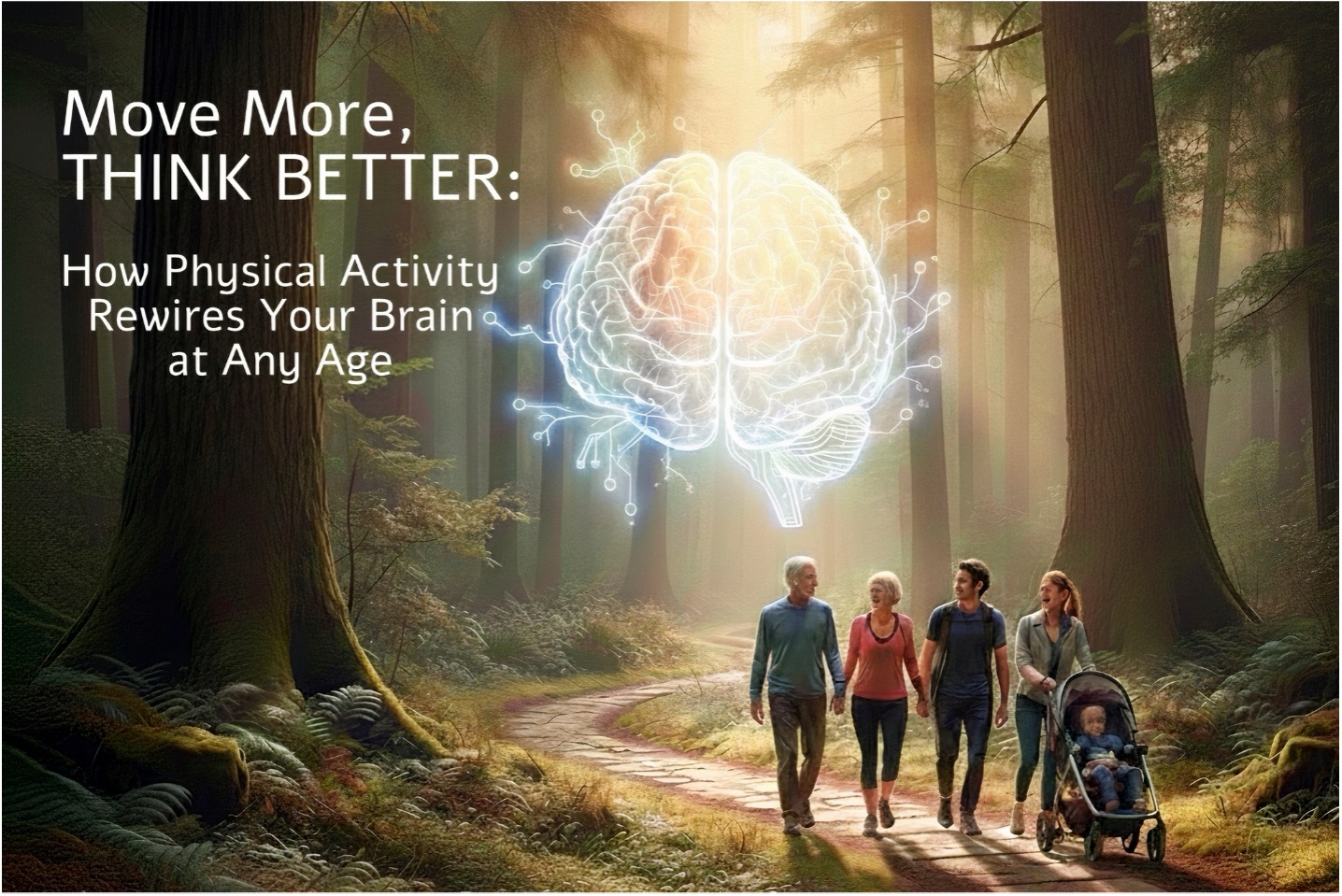
Whether you have in mind one or all of the above, it’s a good time now to introduce to you an activity that will easily improve your life, your brain function, and your peace of mind at minimal cost to you in both your time and your pocketbook. What could this activity be, you might ask? Well, it’s physical activity that can transform your brain chemistry for optimal performance.
Staying physically active as we age substantially reduces our risk of developing dementia and boosts our immune system during our lifetimes, says Gretchen Reynolds in her December 3, 2021, New York Times article. She cited a study, which tracked how often older people move or sat, like a couch potato, and then looked deep inside their brains after death and found that certain vital immune cells worked differently in the brain of those older people who were active compared to their more sedentary peers. These findings add to the growing body of knowledge that when we move our bodies, as we were built to do as humans, we change our minds and brains, no matter how advanced our age.
“Miracle Grow” for the Brain
There is already a plethora of evidence that indicates that physical activity bulks up our brains, if we add about an hour on most days to our exercise program, which can typically add volume to our hippocampus, the brain’s memory center, which reduces or even reverses the common shrinkage that occurs over time. However, exercise is not just for older generations, but middle-aged people can benefit as well to improve brain health as well as heart health, so can children to prevent obesity.
Researchers of exercise-induced neurochemical modulation have shown that physical activity elevates dopamine, which enhances motivation and the brain’s reward circuit. Concurrently, serotonin pathways are activated, stabilizing mood and resilience to stress, while natural endorphins promote well-being and the reduction of pain perception. The result is not only improved mood, but enhanced learning, attention, and focus, as well as memory.
The mechanism of how neuroplasticity occurs was a new discovery made in1982 by neuroscientists, Yes-Alain Barde and Hans Thoenen, with the naming of Brain-Derived Neurotrophic Factor (BDNF) taken initially from pig brains, which originates from the BDNF gene. This factor supports neuron growth, survival, and neurosynaptic plasticity, which makes it a key brain “fertilizer.” Before this and other discoveries, it was believed that the static brain was set in stone and could not grow past childhood, even for those who had strokes, but we had to learn how to moderate exercise.
Avoid overdoing exercise
Many people, especially athletes, believe only long workouts are beneficial. What they do not understand is that exercise’s neurochemical impact is dose-dependent and varies with intensity and duration that is tailored to individual needs, as stated by neuroplastician, Dr. J. J. Kennedy, in his December 4, 2025 blog titled “Exercise & Your Neurochemical Superpowers.” While moderate aerobic exercise can optimize dopamine and serotonin levels, he warns that extremely intense or prolonged activity may induce stress hormones and trigger the Hypothalamic-Pituitary-Adrenal Axis (HPA Axis ) in the brain to release excess cortisol. This action can counteract benefits and compromise immunity if not managed properly with mental conditioning before it occurs.
We have a natural mind-body connection
Dr. Wendy Suzuki, a neuroscientist and professor at the New York University Center for Neural Science and author of Healthy Brain, Happy Life (2015), spoke about the mind-body connection. She explained how the brain can change and grow throughout life through neuroplasticity and how activities like exercise and mindfulness can stimulate this process together.
For those of you who are not athletes and do not have a gym membership there are many easy physical exercises that you can do to start off slowly and to build stamina over time, so this fact itself should ease your fear that you may overdo exercise or not do enough to aid you. Keep in mind that a moderate-intensity aerobic activity like walking alone can significantly improve blood flow, oxygen, and essential proteins, like BDNF, to the brain.
The result is that walking increases the size of the memory center and improves critical thinking, executive functioning, and focus. In addition, the increased blood flow to the brain keeps cells healthy. Walking outdoors offers superior stress reduction, and building up eventually to brisk walking for 30 minutes in your daily routine serves to decrease your anxiety.
How can we get our walking time in for the day?
- Take the stairs whenever possible.
- Park far away from the entrance to stores at the mall.
- Measure your steps on your phone to quantify them.
- Stretch or walk for 5 minutes every hour of work or study.
- Use guided imagery or short app recordings during your break.
- Go to a peaceful, safe place to relax in your mind’s eye.
- Do Yoga-inspired movements in a chair.
- Sit down and peddle on an exercise machine while watching TV.
- Have a conversation on your phone with your friend while exercising at home.
- Play music to slow you down or speed you up.
- Join a gym with like-minded people.
Getting in the Zone
But what if inclement weather keeps you indoors? What if it is raining outside or snowing? What if you have a cold or you can’t go out because of a poor air quality index? What if you can’t walk at all? This is where the power of the mind comes in handy when you can use your imagination to get the cognitive benefits of being in the Zone.
I know this as a peak performance coach because I teach my clients how to access the subconscious mind, where all knowledge is stored, through self-hypnosis and by using imagination to achieve goals and win. It works on this premise: The mind does not know the difference between fantasy and reality.
Mindful Toughness ® skillsets and healthy rewards are:
These skillsets I teach young people can be used by everyone and are portable from one situation to another. Here they are as explained in my book, Wrestling Through Adversity, available on Amazon in audiobook, soft cover, and e-book.
To get in the Zone on your own with self-hypnosis you can:
- Do the Breathing Easy exercise by taking three deep breaths and by progressively relaxing the body from the top of the head to the bottom of the feet.
- Use Mental Rehearsal where you can see, feel, or hear yourself completing a task like walking in a forest or being on the shoreline.
- Use Mental Recall to remember times of the past when you ran the marathon or accomplished some athletic feat.
- Start Positive Self-Talk, where you cancel out any negative words and substitute positive ones. Instead of saying I am too tired to walk, say, I feel energized with each step I take.
- Do a brief Feedback Loop Analysis daily to see how far you’ve come and what you have to do to improve the next time around.
- Give yourself healthy rewards each day after you accomplish your goal.
- Laugh a lot because laughter is the best medicine.
- Put on a happy face because you can’t be sad when you’re smiling.
So, as readers of this blog, what do you say? Have I inspired you to get up from the couch to walk, to meditate, to daydream, and to quiet the mind, body, and spirit? If you are still hesitating and are seated, I suggest that you move more and think again while you can, so you’ll receive these wonderful cognitive benefits—-free of charge— because the mind is an amazing place to be in the New Year 2026.
0 Comments